Netflix released The Blue Road, an eight-episode series, on 20 November. Han Jun-hee directed it and co-wrote the scripts. Son Suk-ku plays Kim Seok, a detective in the Seoul police's mobile investigation unit, and Eita Nagayama plays Inose of the First Investigative Division at Tokyo's Metropolitan Police Department, with Kim Shin-rok, Choi Sung-eun, Jung Jae-young and Kentaro Sakaguchi alongside them. At the press conference, the cast said they shot in Korea, Japan, Hong Kong and Kazakhstan.
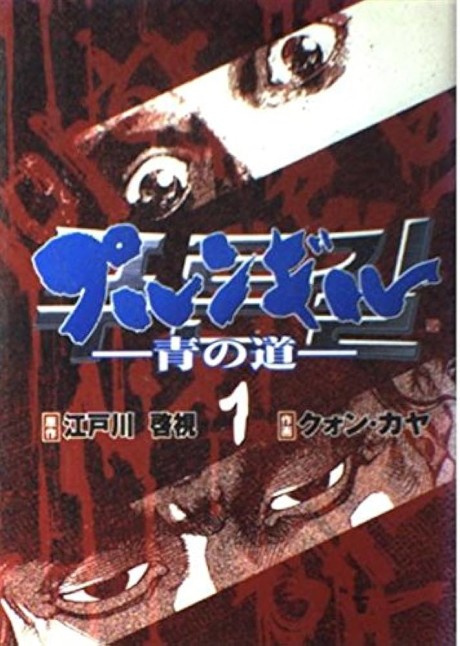
The series comes from a manga of the same name. Its Japanese title, Purungiru: Ao no Michi, writes the Korean words for "blue road" in katakana and adds their meaning in Japanese. Keishi Edogawa wrote it and Kwon Ga-ya drew it. It ran in Weekly Comic Bunch from 7 June 2002 to 8 August 2003, about fourteen months, and fills five volumes. Haksan Publishing put out the Korean edition. Haksan's description introduces Kwon as the artist of Namja Iyagi and Namhansanseong and Edogawa as the story writer of Master Keaton, Billy Bat and Pluto, adding that Edogawa also works under the name Takashi Nagasaki.
The story opens with a run of murders in Korea and Japan. Each victim is found with the joints all over the body twisted, and beside the body is writing in the victim's blood: Korean script at the scenes in Japan, hiragana and kanji at the scenes in Korea. The words are a line from a book on warfare left by a Japanese soldier who went over to the Korean side during the Japanese invasions of Korea in the 1590s. Inose, who has the Shinjuku case, believes the same killer committed a murder in Yokohama, while Kang Cheong-do, who has been chasing similar killings in Korea, crosses to Shinjuku when he hears about the Japanese case.
Inose worked his way up from the bottom and has little time for fast-track officers, so he is prickly with Kang at first. Kang speaks Japanese without an interpreter and fights with taekkyeon. As the two slowly learn to work together, a fifth and then a sixth murder follow, and the case reaches back into the history between the two countries. Japan's colonial rule of Korea, and the different ways Japan and Korea remember it, sit at the centre of the manga.
According to Japanese Wikipedia, every volume closes with a page addressed to readers. It says the work is not a translation but a new work made for readers in both Japan and Korea, and that it is not meant to feed prejudice.
The series changes a great deal. The Hankyoreh reports that the two detectives, a father-and-son age gap apart in the manga, are now close in age, and that the Korean detective has been renamed from Kang Cheong-do to Kim Seok. Two characters are new: a Korean-Japanese businesswoman played by Kim Shin-rok and a government agent played by Choi Sung-eun. Yonhap reported that in the series the title also points to the road Koryo-saram, ethnic Koreans in the Soviet Union, were forced along when they were deported. The ending is different too.
In Korea, Haksan's edition is listed as complete on the comics service Mr. Blue, where it can be rented.